Automation in DevOps (DevSecOps): Integrating Security into the Pipeline
In modern DevOps practices, security can no longer be an afterthought — it needs to be embedded throughout the software development lifecycle (SDLC). This approach, known as DevSecOps, integrates security automation into DevOps workflows to ensure applications remain secure without slowing down development.
Why Security Automation?
Traditional security models relied on manual code reviews and vulnerability assessments at the end of the development cycle, often leading to bottlenecks and delayed releases. Security automation addresses these issues by:
✔️ Detecting vulnerabilities early in the CI/CD pipeline
✔️ Reducing manual intervention and human error
✔️ Ensuring continuous compliance with industry regulations
✔️ Improving incident response time
Key Areas of Security Automation in DevOps
1. Automated Code Security (Static & Dynamic Analysis)
- Static Application Security Testing (SAST): Scans source code for vulnerabilities before deployment (e.g., SonarQube, Checkmarx).
- Dynamic Application Security Testing (DAST): Identifies security flaws in running applications (e.g., OWASP ZAP, Burp Suite).
- Software Composition Analysis (SCA): Detects vulnerabilities in third-party dependencies (e.g., Snyk, WhiteSource).
🔹 Example: Running SAST scans automatically in a Jenkins pipeline to detect insecure coding practices before merging code.
2. Secrets Management & Access Control
- Automating the detection and handling of hardcoded secrets, API keys, and credentials using tools like HashiCorp Vault, AWS Secrets Manager, and CyberArk.
- Implementing least privilege access via automated IAM policies to ensure only authorized users and services can access sensitive data.
🔹 Example: Using HashiCorp Vault to generate and revoke temporary credentials dynamically instead of hardcoding them.
3. Automated Compliance & Policy Enforcement
- Infrastructure as Code (IaC) security scans using Checkov, OPA (Open Policy Agent), or Terraform Sentinel ensure that cloud configurations follow security best practices.
- Automated audits and reporting help maintain compliance with GDPR, HIPAA, SOC 2, and ISO 27001 standards.
🔹 Example: Using Checkov to scan Terraform code for misconfigurations before provisioning cloud resources.
4. Container & Kubernetes Security
- Scanning container images for vulnerabilities using Trivy, Aqua Security, or Anchore before pushing them to a registry.
- Implementing Kubernetes security policies (e.g., Pod Security Policies, Kyverno, or Gatekeeper) to enforce security rules.
🔹 Example: Using Trivy in a CI/CD pipeline to scan Docker images before deployment to Kubernetes.
5. Continuous Security Monitoring & Threat Detection
- Implementing SIEM (Security Information and Event Management) tools like Splunk, ELK Stack, or AWS Security Hub for real-time security event detection.
- Using Intrusion Detection Systems (IDS) and Intrusion Prevention Systems (IPS) (e.g., Snort, Suricata) to detect and respond to security threats.
- AI-driven anomaly detection via Amazon GuardDuty, Microsoft Defender for Cloud, or Google Chronicle.
🔹 Example: Configuring AWS Security Hub to automatically detect and alert on misconfigurations in an AWS environment.
6. Automated Incident Response & Remediation
- Using SOAR (Security Orchestration, Automation, and Response) platforms like Splunk SOAR or Palo Alto Cortex XSOAR to automate security incident triage and response.
- Creating automated playbooks for threat mitigation, such as isolating compromised containers or blocking suspicious IPs.
🔹 Example: Automating AWS Lambda functions to quarantine an EC2 instance when an anomaly is detected.
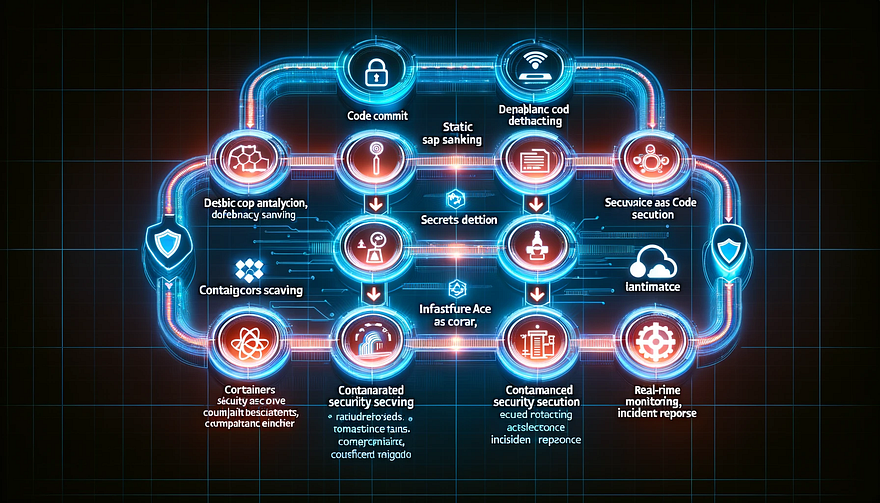
Bringing It All Together: A DevSecOps Pipeline Example
1️⃣ Code Commit: Developers push code to a Git repository.
2️⃣ Static Code Analysis: SAST tools scan for vulnerabilities.
3️⃣ Dependency Scanning: SCA tools check third-party libraries.
4️⃣ Secrets Detection: Git hooks or automated scanners look for hardcoded secrets.
5️⃣ Container Security: Images are scanned before being pushed to a container registry.
6️⃣ Infrastructure as Code Scanning: Terraform or Kubernetes configurations are checked.
7️⃣ Automated Security Testing: DAST and penetration tests run in staging.
8️⃣ Compliance Checks: Policies are enforced before deployment.
9️⃣ Real-time Monitoring: Logs and security events are analyzed for threats.
🔟 Incident Response: Automated workflows handle detected threats.
Final Thoughts
Security automation in DevOps is critical for ensuring that security does not slow down development. By integrating automated security testing, policy enforcement, and monitoring, teams can build resilient, compliant, and secure applications without sacrificing speed.
WEBSITE: https://www.ficusoft.in/devops-training-in-chennai/


Comments
Post a Comment