What is DevSecOps? Integrating Security into the DevOps Pipeline
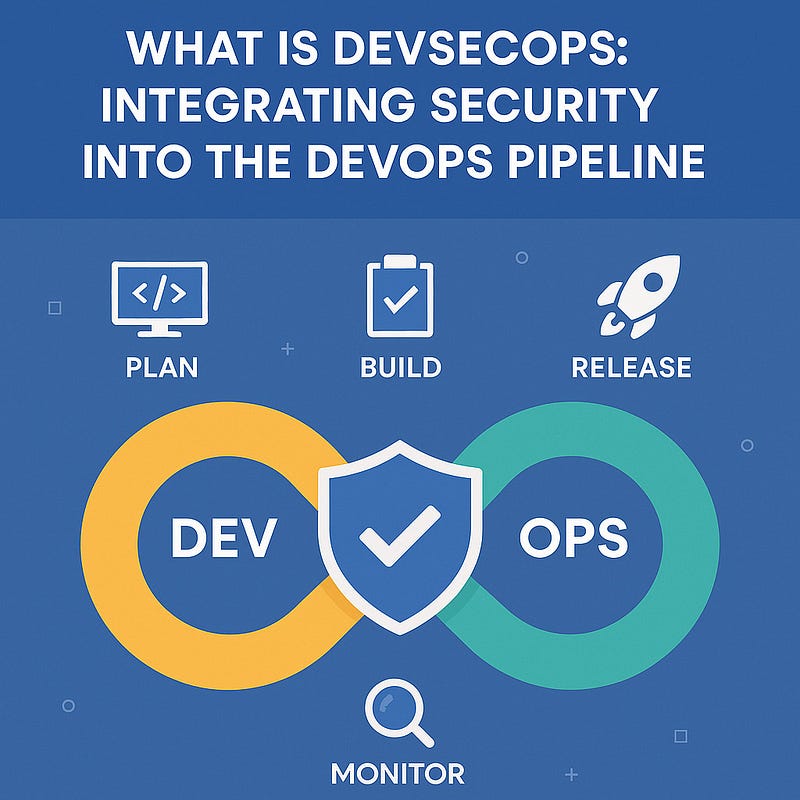
What is DevSecOps? Integrating Security into the DevOps Pipeline
In today’s fast-paced digital landscape, delivering software quickly isn’t just a competitive advantage — it’s a necessity. Enter DevOps: the fusion of development and operations, aimed at streamlining software delivery through automation, collaboration, and continuous improvement. But as we build faster, we must also build safer. That’s where DevSecOps comes in.
What is DevSecOps?
DevSecOps stands for Development, Security, and Operations. It’s an evolution of the DevOps philosophy that embeds security practices directly into the DevOps pipeline — from planning to production. Instead of treating security as a final step or a separate process, DevSecOps makes it an integral part of the development lifecycle.
In short: DevSecOps = DevOps + Continuous Security.
Why DevSecOps Matters
Traditional security models often acted as bottlenecks, kicking in late in the software lifecycle, causing delays and costly rework. In contrast, DevSecOps:
- Shifts security left — addressing vulnerabilities early in development.
- Promotes automation of security checks (e.g., static code analysis, dependency scanning).
- Encourages collaboration between developers, security teams, and operations.
The result? Secure, high-quality code delivered at speed.
Key Principles of DevSecOps
- Security as Code
Just like infrastructure can be managed through code (IaC), security rules and policies can be codified, versioned, and automated. - Continuous Threat Modeling
Teams assess risk and architecture regularly, adapting to changes in application scope or external threats. - Automated Security Testing
Security tools are integrated into CI/CD pipelines to scan for vulnerabilities, misconfigurations, or compliance issues. - Culture of Shared Responsibility
Security isn’t just the InfoSec team’s job. Everyone in the pipeline — from devs to ops — has a role in maintaining secure systems. - Monitoring and Incident Response
Real-time logging, monitoring, and alerting help detect suspicious behavior before it becomes a breach.
How to Integrate DevSecOps into Your Pipeline
Here’s a high-level roadmap to start embedding security into your DevOps process:
- Plan Securely: Include security requirements and threat models during planning.
- Develop Secure Code: Train developers in secure coding practices. Use linters and static analysis tools.
- Build with Checks: Integrate SAST (Static Application Security Testing) and SCA (Software Composition Analysis) into your build process.
- Test Continuously: Run DAST (Dynamic Application Security Testing), fuzzing, and penetration testing automatically.
- Release with Confidence: Use automated security gates to ensure only secure builds go to production.
- Monitor Proactively: Enable real-time monitoring, anomaly detection, and centralized logging.
Popular DevSecOps Tools
- SAST: SonarQube, Checkmarx, Fortify
- DAST: OWASP ZAP, Burp Suite
- SCA: Snyk, WhiteSource, Black Duck
- Secrets Detection: GitGuardian, TruffleHog
- Container Security: Aqua Security, Prisma Cloud, Clair
Final Thoughts
DevSecOps is not just about tools — it’s a mindset shift. It breaks down silos between development, operations, and security teams, making security a shared, continuous responsibility. By baking security into every stage of your pipeline, you ensure your applications are not only fast and reliable — but also secure by design.
WEBSITE: https://www.ficusoft.in/devops-training-in-chennai/


Comments
Post a Comment