Big Data and Data Engineering
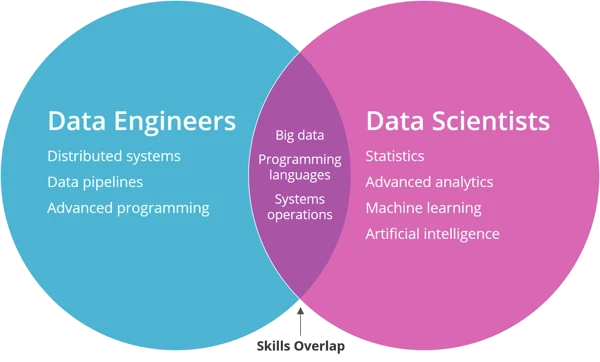
Big Data and Data Engineering are essential concepts in modern data science, analytics, and machine learning.
They focus on the processes and technologies used to manage and process large volumes of data.
Here’s an overview:
- What is Big Data? Big Data refers to extremely large datasets that cannot be processed or analyzed using traditional data processing tools or methods.
It typically has the following characteristics:
Huge amounts of data (petabytes or more).
Data comes in different formats (structured, semi-structured, unstructured). Velocity: The speed at which data is generated and processed.
Veracity: The quality and accuracy of data.
Value: Extracting meaningful insights from data.
Big Data is often associated with technologies and tools that allow organizations to store, process, and analyze data at scale.
Overview Data Engineering is the process of designing, building, and managing the systems and infrastructure required to collect, store, process, and analyze data.
The goal is to make data easily accessible for analytics and decision-making.
Key areas of Data Engineering:
Gathering data from various sources (e.g., IoT devices, logs, APIs). Data Storage: Storing data in data lakes, databases, or distributed storage systems. Data Processing: Cleaning, transforming, and aggregating raw data into usable formats.
Combining data from multiple sources to create a unified dataset for analysis.
3. Big Data Technologies and Tools
The following tools and technologies are commonly used in Big Data and Data Engineering to manage and process large datasets:
Data Lakes: Large storage systems that can handle structured, semi-structured, and unstructured data. Examples include Amazon S3, Azure Data Lake, and Google Cloud Storage.
Systems that allow data to be stored across multiple machines. Examples include Hadoop HDFS and Apache Cassandra.
Relational databases (e.g., MySQL, PostgreSQL) and NoSQL databases (e.g., MongoDB, Cassandra, HBase).
Batch Processing: Handling large volumes of data in scheduled, discrete chunks.
Apache Hadoop (MapReduce framework). Apache Spark (offers both batch and stream processing).
Handling real-time data flows. Common tools: Apache Kafka (message broker). Apache Flink (streaming data processing). Apache Storm (real-time computation).
ETL (Extract, Transform, Load):
Tools like Apache Nifi, Airflow, and AWS Glue are used to automate data extraction, transformation, and loading processes.
Data Orchestration & Workflow Management:
Apache Airflow is a platform for programmatically authoring, scheduling, and monitoring workflows. Kubernetes and Docker are used to deploy and scale applications in data pipelines.
Amazon Redshift, Google BigQuery, Snowflake, and Azure Synapse Analytics are popular cloud data warehouses for large-scale data analytics.
Apache Hive is a data warehouse built on top of Hadoop to provide SQL-like querying capabilities.
Tools like Great Expectations, Deequ, and AWS Glue DataBrew help ensure data quality by validating, cleaning, and transforming data before it’s analyzed.
The typical lifecycle in Data Engineering involves the following stages: Data Ingestion: Collecting and importing data from various sources into a central storage system.
This could include real-time ingestion using tools like Apache Kafka or batch-based ingestion using Apache Sqoop.
Data Transformation (ETL/ELT): After ingestion, raw data is cleaned and transformed.
Data normalization and standardization. Removing duplicates and handling missing data.
Aggregating or merging datasets. Using tools like Apache Spark, AWS Glue, and Talend.
After transformation, the data is stored in a format that can be easily queried.
This could be in a data warehouse (e.g., Snowflake, Google BigQuery) or a data lake (e.g., Amazon S3).
Data Analytics & Visualization:
After the data is stored, it is ready for analysis. Data scientists and analysts use tools like SQL, Jupyter Notebooks, Tableau, and Power BI to create insights and visualize the data.
In some use cases, data is deployed to serve real-time queries using tools like Apache Druid or Elasticsearch.
5. Challenges in Big Data and Data Engineering
Ensuring that data is secure, encrypted, and complies with privacy regulations (e.g., GDPR, CCPA).
As data grows, the infrastructure needs to scale to handle it efficiently.
Ensuring that the data collected is accurate, complete, and relevant. Data
Combining data from multiple systems with differing formats and structures can be complex.
Managing data that flows continuously and needs to be processed in real-time.
6. Best Practices in Data Engineering Modular Pipelines:
Design data pipelines as modular components that can be reused and updated independently.
Data Versioning: Keep track of versions of datasets and data models to maintain consistency.
Data Lineage: Track how data moves and is transformed across systems.
Automation: Automate repetitive tasks like data collection, transformation, and processing using tools like Apache Airflow or Luigi.
Monitoring: Set up monitoring and alerting to track the health of data pipelines and ensure data accuracy and timeliness.
7. Cloud and Managed Services for Big Data
Many companies are now leveraging cloud-based services to handle Big Data:
Offers tools like AWS Glue (ETL), Redshift (data warehousing), S3 (storage), and Kinesis (real-time streaming).
Provides Azure Data Lake, Azure Synapse Analytics, and Azure Databricks for Big Data processing.
Google Cloud:
Offers BigQuery, Cloud Storage, and Dataflow for Big Data workloads.
Data Engineering plays a critical role in enabling efficient data processing, analysis, and decision-making in a data-driven world.
WEBSITE: https://www.ficusoft.in/data-science-course-in-chennai/


Comments
Post a Comment