Introduction to GraphQL for Full Stack Applications
What is GraphQL?
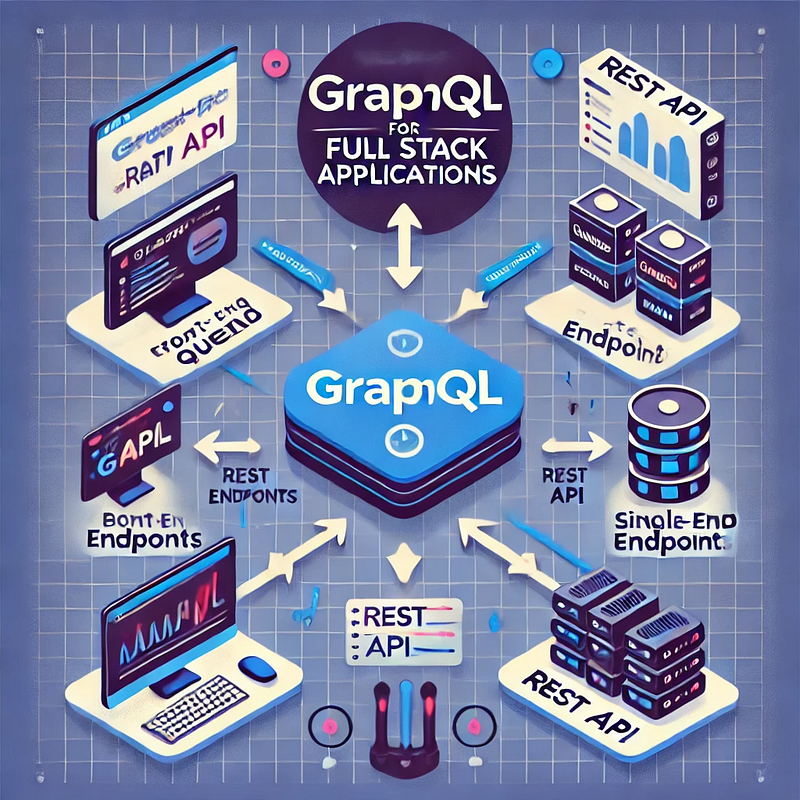
GraphQL is a query language for APIs and a runtime for executing those queries by leveraging a type system defined for the data. Developed by Facebook in 2012 and open-sourced in 2015, GraphQL provides a flexible and efficient alternative to REST APIs by allowing clients to request exactly the data they need — nothing more, nothing less.
Why Use GraphQL for Full Stack Applications?
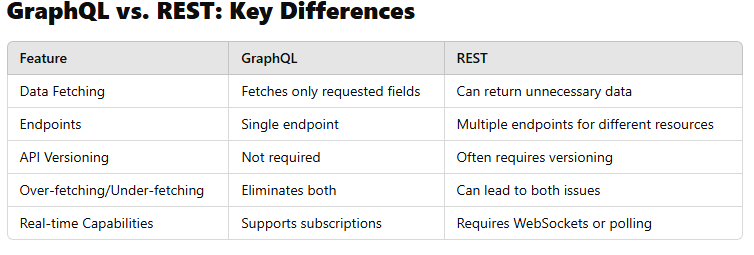
Traditional REST APIs often come with challenges such as over-fetching, under-fetching, and versioning complexities. GraphQL solves these issues by offering:
- Flexible Queries: Clients can specify exactly what data they need.
- Single Endpoint: Unlike REST, which may require multiple endpoints, GraphQL exposes a single endpoint for all queries.
- Strongly Typed Schema: Ensures clear data structure and validation.
- Efficient Data Fetching: Reduces network overhead by retrieving only necessary fields.
- Easier API Evolution: No need for versioning — new fields can be added without breaking existing queries.
GraphQL vs. REST: Key Differences
Core Concepts of GraphQL
1. Schema & Types
GraphQL APIs are built on schemas that define the data structure.
Example schema:
graphqltype User {
id: ID!
name: String!
email: String!
}type Query {
getUser(id: ID!): User
}2. Queries
Clients use queries to request specific data.
graphqlquery {
getUser(id: "123") {
name
email
}
}3. Mutations
Used to modify data (Create, Update, Delete).
graphqlmutation {
createUser(name: "John Doe", email: "john@example.com") {
id
name
}
}4. Subscriptions
Enable real-time updates using Web Sockets.
graphqlsubscription {
newUser {
id
name
}
}Setting Up GraphQL in a Full Stack Application
Backend: Implementing GraphQL with Node.js and Express
GraphQL servers can be built using Apollo Server, Express-GraphQL, or other libraries.
Example setup with Apollo Server:
javascriptimport { ApolloServer, gql } from "apollo-server";
const typeDefs = gql`
type Query {
hello: String
}
`;const resolvers = {
Query: {
hello: () => "Hello, GraphQL!",
},
};const server = new ApolloServer({ typeDefs, resolvers });server.listen().then(({ url }) => {
console.log(`Server running at ${url}`);
});Frontend: Querying GraphQL with React and Apollo Client
Example React component using Apollo Client:
javascriptimport { useQuery, gql } from "@apollo/client";const GET_USER = gql`
query {
getUser(id: "123") {
name
}
}
`;
function User() {
  const { loading, error, data } = useQuery(GET_USER);
  if (loading) return <p>Loading...</p>;
  if (error) return <p>Error: {error.message}</p>;
return <div>{data.getUser.name} - {data.getUser.email}</div>;
}GraphQL Best Practices for Full Stack Development
- Use Batching and Caching: Tools like Apollo Client optimize performance.
- Secure the API: Implement authentication and authorization.
- Optimize Resolvers: Use DataLoader to prevent N+1 query problems.
- Enable Rate Limiting: Prevent abuse and excessive API calls.
Conclusion
GraphQL provides a powerful and efficient way to manage data fetching in full-stack applications. By using GraphQL, developers can optimize API performance, reduce unnecessary data transfer, and create a more flexible architecture.
Whether you’re working with React, Angular, Vue, or any backend framework, GraphQL offers a modern alternative to traditional REST APIs.
WEBSITE: https://www.ficusoft.in/full-stack-developer-course-in-chennai/


Comments
Post a Comment