Serverless DevOps: How Lambda and Cloud Functions Fit In

Introduction to Serverless DevOps: What It Is and Why It Matters
1. What Is Serverless DevOps?
Serverless DevOps is a modern approach to software development and operations that leverages serverless computing for automating CI/CD pipelines, infrastructure management, and deployments — without provisioning or maintaining servers.
Key Features of Serverless DevOps
✅ No Server Management: Developers focus on writing code while cloud providers handle scaling and infrastructure.
✅ Event-Driven Automation: Functions (e.g., AWS Lambda, Google Cloud Functions) are triggered by events like code commits or API requests.
✅ Cost-Efficient: Pay only for execution time, reducing costs compared to always-on infrastructure.
✅ Scalability: Auto-scales based on demand, ensuring high availability.
✅ Faster Development & Deployment: CI/CD pipelines can be entirely serverless, improving deployment speed.
2. Why Does Serverless Matter for DevOps?
Traditional DevOps practices require managing infrastructure for CI/CD, monitoring, and deployments. Serverless DevOps eliminates this complexity, making DevOps workflows:
🔹 More Agile → Deploy new features quickly without worrying about infrastructure.
🔹 More Reliable → Auto-scaling and built-in fault tolerance ensure high availability.
🔹 More Cost-Effective → No need to run VMs or containers 24/7.
🔹 More Efficient → Automate workflows using functions instead of dedicated servers.
3. How Serverless DevOps Works
A typical Serverless DevOps workflow consists of:
1️⃣ Code Commit → Developer pushes code to a repository (GitHub, CodeCommit, Bitbucket).
2️⃣ Trigger Build Process → AWS Lambda or Cloud Functions start the CI/CD process.
3️⃣ Code Testing & Packaging → AWS Code Build or Cloud Build compiles and tests code.
4️⃣ Deployment → Code is deployed to a serverless platform (AWS Lambda, Cloud Functions, or Fargate).
5️⃣ Monitoring & Logging → Serverless monitoring tools track performance and errors.
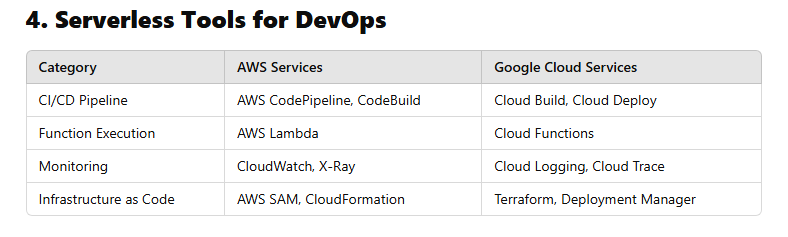
4. Serverless Tools for DevOps
5. Conclusion
Serverless DevOps accelerates software delivery, reduces costs, and improves scalability by automating deployments without managing servers.
Whether using AWS Lambda or Google Cloud Functions, integrating serverless into DevOps workflows enables faster, more efficient development cycles.
WEBSITE: https://www.ficusoft.in/devops-training-in-chennai/


Comments
Post a Comment