Share tips for improving code quality and maintainability.
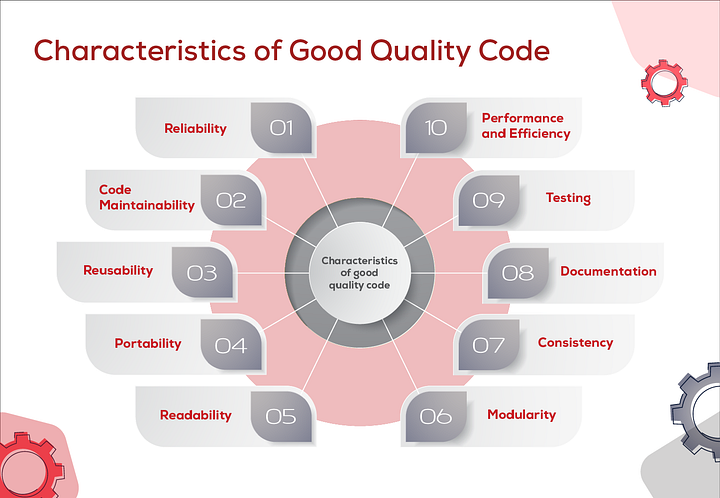
1. Follow Java Naming Conventions
- Classes: Use PascalCase for class names (e.g.,
EmployeeDetails). - Methods/Variables: Use camelCase for method and variable names (e.g.,
calculateSalary). - Constants: Use uppercase letters with underscores for constants (e.g.,
MAX_LENGTH).
2. Use Proper Object-Oriented Principles
- Encapsulation: Make fields private and provide public getters and setters to access them.
- Inheritance: Reuse code via inheritance but avoid deep inheritance hierarchies that can create tightly coupled systems.
- Polymorphism: Use polymorphism to extend functionalities without changing existing code.
3. Write Clean and Readable Code
- Keep Methods Small: Each method should do one thing and do it well. If a method is too long or does too much, break it down into smaller methods.
- Avoid Nested Loops/Conditionals: Too many nested loops or conditionals can make code hard to read. Extract logic into separate methods or use design patterns like the Strategy or State pattern.
4. Use Design Patterns
- Leverage proven design patterns like Singleton, Factory, Observer, and Strategy to solve common problems in a standardized, maintainable way.
- Avoid overcomplicating things; use patterns only when they add clarity and solve a specific problem.
5. Implement Proper Error Handling
- Use exceptions appropriately. Don’t overuse them, and catch only the exceptions you can handle.
- Ensure that exceptions are logged for better debugging and auditing.
- Use custom exceptions to represent domain-specific issues, so they are easier to debug.
6. Utilize Java’s Stream API
- The Stream API (introduced in Java 8) helps reduce boilerplate code when performing collection operations like filtering, mapping, and reducing.
- It makes code more concise and expressive, which helps with readability and maintainability.
7. Write Unit Tests
- Use JUnit and Mockito for unit testing and mocking dependencies.
- Write test cases for all critical methods and components to ensure the behavior is as expected.
- Use Test-Driven Development (TDD) to ensure code correctness from the start.
8. Use Dependency Injection
- Prefer Dependency Injection (DI) for managing object creation and dependencies. This decouples components and makes testing easier (using tools like Spring Framework or Guice).
- DI helps to make your classes more modular and improves maintainability.
9. Avoid Code Duplication
- Use methods or utility classes to avoid repeating code.
- If the same logic is used in multiple places, refactor it into a single reusable method.
10. Use Annotations
- Use Java annotations (like
@Override,@NotNull,@Entity, etc.) to improve code clarity and reduce boilerplate code. - Annotations help to enforce business logic and constraints without having to manually check them.
11. Leverage IDE Features
- Use tools like IntelliJ IDEA or Eclipse to automatically format code and identify potential issues.
- Many IDEs have integrated tools for running tests, refactoring code, and applying coding standards, so make full use of these features.
12. Optimize for Performance Without Sacrificing Readability
- Only optimize performance when necessary. Premature optimization can lead to complex code that’s difficult to maintain.
- Profile your code to identify bottlenecks, but prioritize clarity and maintainability over micro-optimizations.
13. Implement Proper Logging
- Use a logging framework like SLF4J with Logback or Log4j2 for logging. This provides a consistent logging mechanism across the application.
- Ensure that logs are meaningful, providing information about the application’s state, errors, and flow, but avoid excessive logging that clutters output.
14. Document Your Code
- Use JavaDocs to generate documentation for public methods and classes.
- Document not just the what but also the why behind critical decisions in the codebase.
15. Keep Your Codebase Modular
- Break your project into smaller, well-defined modules, and avoid large monolithic classes.
- Use packages to group related classes, ensuring that each class or module has a single responsibility.
16. Use Static Analysis Tools
- Integrate tools like Checkstyle, PMD, and SonarQube to enforce coding standards, detect bugs, and ensure code quality.
- These tools help you identify code smells and areas where quality can be improved.
WEBSITE: https://www.ficusoft.in/core-java-training-in-chennai/


Comments
Post a Comment