Terraform vs. CloudFormation: Choosing the Right IaC Tool
Terraform vs. CloudFormation: Choosing the Right IaC Tool
Infrastructure as Code (IaC) has become a fundamental practice in modern cloud computing, allowing organizations to automate infrastructure provisioning and management.
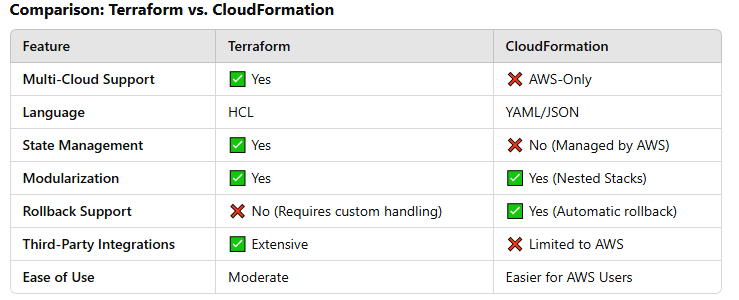
Two of the most widely used IaC tools are Terraform and AWS Cloud Formation. While both enable infrastructure automation, they differ in functionality, scope, and usability.
What is Terraform?
Terraform is an open-source IaC tool developed by HashiCorp that allows users to define, manage, and provision infrastructure across multiple cloud providers. It uses HashiCorp Configuration Language (HCL) and supports a declarative approach to infrastructure deployment.
Key Features of Terraform:
✅ Multi-Cloud Support — Works across AWS, Azure, GCP, and on-premises environments.
✅ State Management — Uses a state file to track the current infrastructure and changes.
✅ Modular Infrastructure — Supports reusable modules to simplify complex deployments.
✅ Immutable Infrastructure — Ensures infrastructure changes are consistently applied.
✅ Third-Party Provider Support — Integrates with Kubernetes, databases, monitoring tools, etc.
How Terraform Works:
- Write Configuration — Define infrastructure in HCL.
- Initialize — Run
terraform initto prepare the working directory. - Plan Changes — Use
terraform planto preview changes before applying them. - Apply Changes — Execute
terraform applyto provision infrastructure. - State Management — Terraform tracks resource changes in a state file.
Pros of Terraform:
- Cloud-agnostic, enabling multi-cloud deployments.
- Strong community support with a vast ecosystem of providers.
- Modularization allows reusable configurations.
- Provides an execution plan before making changes.
Cons of Terraform:
- Requires manual state locking unless using remote state storage.
- Learning curve due to HCL syntax and state management.
- No built-in rollback mechanism like Cloud Formation.
What is AWS Cloud Formation?
AWS CloudFormation is an AWS-native IaC service that enables users to define and provision AWS resources using JSON or YAML templates. Unlike Terraform, which supports multiple cloud platforms, CloudFormation is designed exclusively for AWS environments.
Key Features of Cloud Formation:
✅ AWS-Native Integration — Deeply integrated with AWS services for seamless resource management.
✅ Stack-Based Deployment — Uses CloudFormation stacks to deploy and manage groups of resources.
✅ Drift Detection — Identifies discrepancies between deployed resources and template definitions.
✅ Rollback Protection — Automatically reverts changes if an update fails.
✅ Cross-Account & Cross-Region Stacks — Supports resource sharing across AWS accounts and regions.
How Cloud Formation Works:
- Write Template — Define resources in JSON or YAML.
- Create Stack — Deploy infrastructure using AWS Management Console, CLI, or SDKs.
- Monitor Stack Progress — AWS CloudFormation handles dependencies and provisions resources.
- Update Stack — Modify the template and apply updates without redeploying everything.
- Rollback on Failure — Automatic rollback ensures failed changes don’t break infrastructure.
Pros of Cloud Formation:
- Native support for AWS services with seamless integration.
- Automated rollback and drift detection.
- No need to manage external state files.
- Easier to use for AWS-exclusive environments.
Cons of CloudFormation:
- Limited to AWS, making multi-cloud deployments challenging.
- No built-in support for non-AWS services.
- More complex YAML/JSON syntax compared to Terraform’s HCL.
Use Terraform If:
✅ You need multi-cloud support (AWS, Azure, GCP, etc.).
✅ You require third-party integrations (Kubernetes, monitoring tools, SaaS applications).
✅ You want a declarative, flexible, and modular IaC approach.
✅ You prefer an active open-source community and extensive support.
Use CloudFormation If:
✅ You are working exclusively within AWS.
✅ You want built-in rollback and drift detection.
✅ You need AWS-native automation with strong security integration.
✅ You prefer AWS-supported and managed infrastructure state.
Conclusion
Both Terraform and Cloud Formation are powerful Infrastructure as Code tools, but their suitability depends on your requirements. Terraform is ideal for teams working in multi-cloud environments, while CloudFormation is best for AWS-exclusive deployments that need built-in rollback and security integration.
If your team needs flexibility and cloud-agnostic deployments, Terraform is the better choice. However, if you are deeply invested in AWS and prefer a fully managed IaC service, Cloud Formation is the way to go.
WEBSITE: https://www.ficusoft.in/devops-training-in-chennai/


Comments
Post a Comment