Understanding Neural Networks: Building Blocks of Deep Learning
Introduction
- Briefly introduce neural networks and their role in deep learning.
- Mention real-world applications (e.g., image recognition, NLP, self-driving cars).
- Provide a simple analogy (e.g., comparing neurons in the brain to artificial neurons in a network).
1. What is a Neural Network?
- Define neural networks in the context of artificial intelligence.
- Explain how they are inspired by the human brain.
- Introduce basic terms: neurons, layers, activation functions.
2. Architecture of a Neural Network
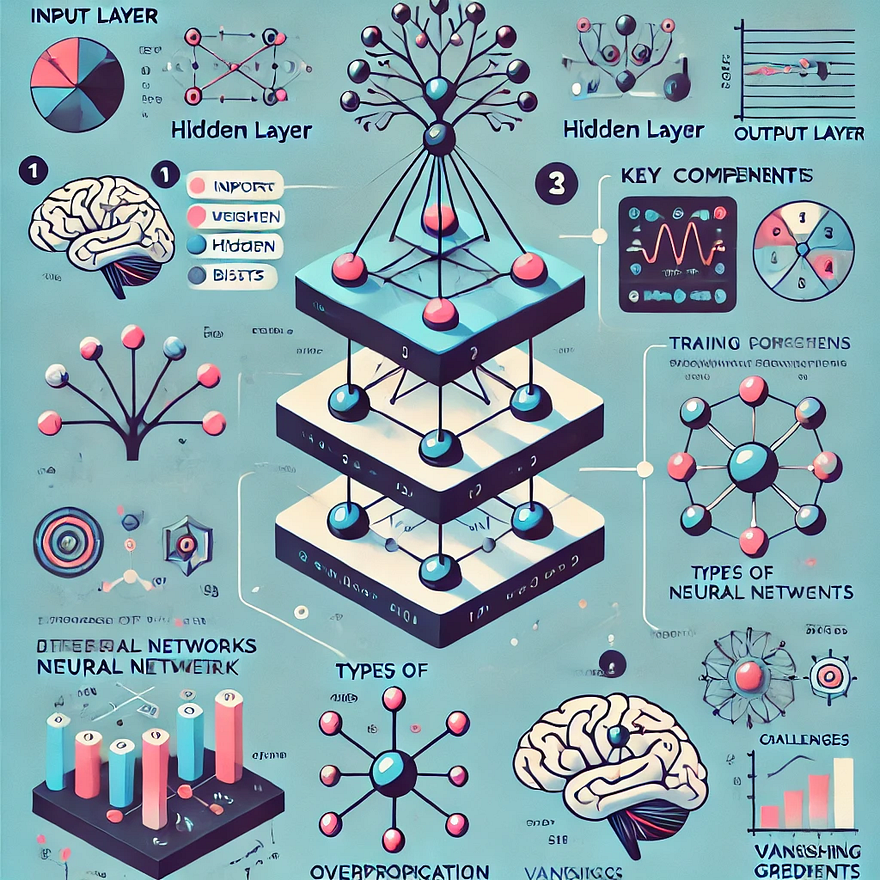
- Input Layer: Where data enters the network.
- Hidden Layers: Where computations happen.
- Output Layer: Produces predictions.
- Visual representation of a simple feedforward network.
3. Key Components of Neural Networks
- Weights & Biases: How they influence predictions.
- Activation Functions: ReLU, Sigmoid, Tanh (with examples).
- Loss Function: Measures model performance (MSE, Cross-Entropy).
- Backpropagation & Gradient Descent: Learning process of the network.
4. Types of Neural Networks
- Feedforward Neural Networks (FNN)
- Convolutional Neural Networks (CNNs): For image processing.
- Recurrent Neural Networks (RNNs): For sequential data like text & speech.
- Transformers: Modern architecture for NLP (BERT, GPT).
5. Training a Neural Network
- Data preprocessing: Normalization, encoding, augmentation.
- Splitting dataset: Training, validation, and test sets.
- Hyperparameter tuning: Learning rate, batch size, number of layers.
6. Challenges in Neural Networks
- Overfitting & Underfitting.
- Vanishing & Exploding Gradients.
- Computational cost and scalability.
7. Tools & Frameworks for Building Neural Networks
- TensorFlow, Keras, PyTorch.
- Example: Simple neural network in Python.
Conclusion
- Recap key takeaways.
- Encourage exploration of deep learning projects.
WEBSITE: https://www.ficusoft.in/deep-learning-training-in-chennai/


Comments
Post a Comment