What is Big Data? Understanding Volume, Velocity, and Variety
Introduction
- Definition of Big Data and its growing importance in today’s digital world.
- How organizations use Big Data for insights, decision-making, and innovation.
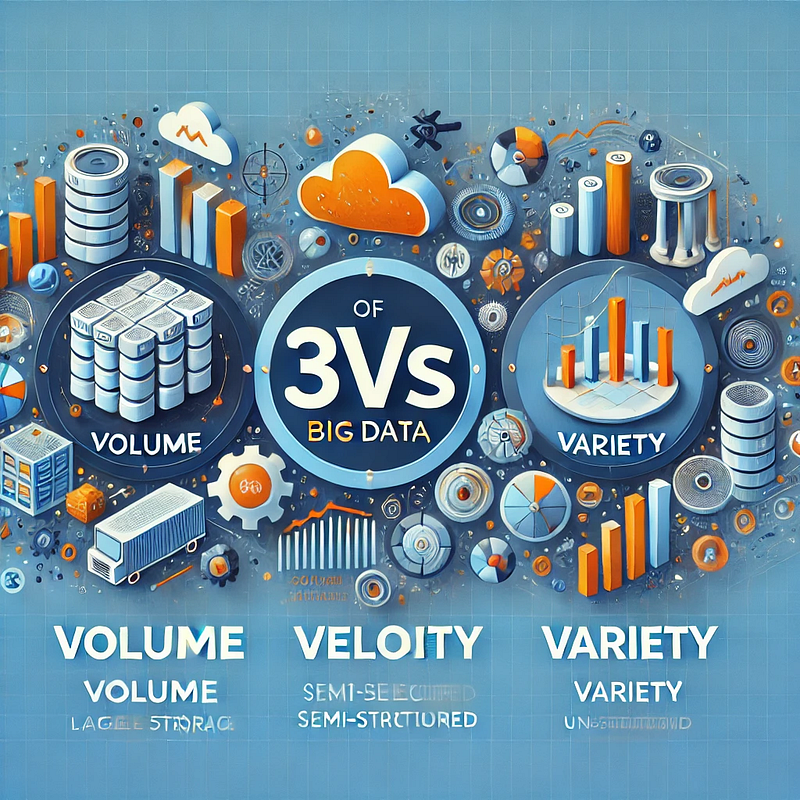
- Brief introduction to the 3Vs of Big Data: Volume, Velocity, and Variety.
1. The Three Pillars of Big Data
1.1 Volume: The Scale of Data
- Massive amounts of data generated from sources like social media, IoT devices, and enterprise applications.
- Examples:
- Facebook processes 4 petabytes of data per day.
- Banking transactions generate terabytes of logs.
- Technologies used to store and process large volumes: Hadoop, Apache Spark, Data Lakes.
1.2 Velocity: The Speed of Data Processing
- Real-time and near-real-time data streams.
- Examples:
- Stock market transactions occur in microseconds.
- IoT devices send continuous sensor data.
- Streaming services like Netflix analyze user behavior in real time.
- Technologies enabling high-velocity processing: Apache Kafka, Apache Flink, AWS Kinesis, Google BigQuery.
1.3 Variety: The Different Forms of Data
- Structured, semi-structured, and unstructured data.
- Examples:
- Structured: Databases (SQL, Oracle).
- Semi-structured: JSON, XML, NoSQL databases.
- Unstructured: Emails, videos, social media posts.
- Tools for handling diverse data types: NoSQL databases (MongoDB, Cassandra), AI-driven analytics.
2. Why Big Data Matters
- Improved business decision-making using predictive analytics.
- Personalization in marketing and customer experience.
- Enhancing healthcare, finance, and cybersecurity with data-driven insights.
3. Big Data Technologies & Ecosystem
- Data Storage: Hadoop Distributed File System (HDFS), Amazon S3, Google Cloud Storage.
- Processing Frameworks: Apache Spark, Apache Hadoop.
- Streaming Analytics: Apache Kafka, Apache Flink.
- Big Data Databases: Cassandra, MongoDB, Google Bigtable.
4. Challenges & Future of Big Data
- Data privacy and security concerns (GDPR, CCPA compliance).
- Scalability and infrastructure costs.
- The rise of AI and machine learning for Big Data analytics.
Conclusion
- Recap of Volume, Velocity, and Variety as the foundation of Big Data.
- How businesses can leverage Big Data for competitive advantage.
- The future of Big Data with AI, edge computing, and cloud integration.
WEBSITE: https://www.ficusoft.in/data-science-course-in-chennai/


Comments
Post a Comment