Azure Data Factory for Financial Services: Ensuring Compliance and Secure Data Movement
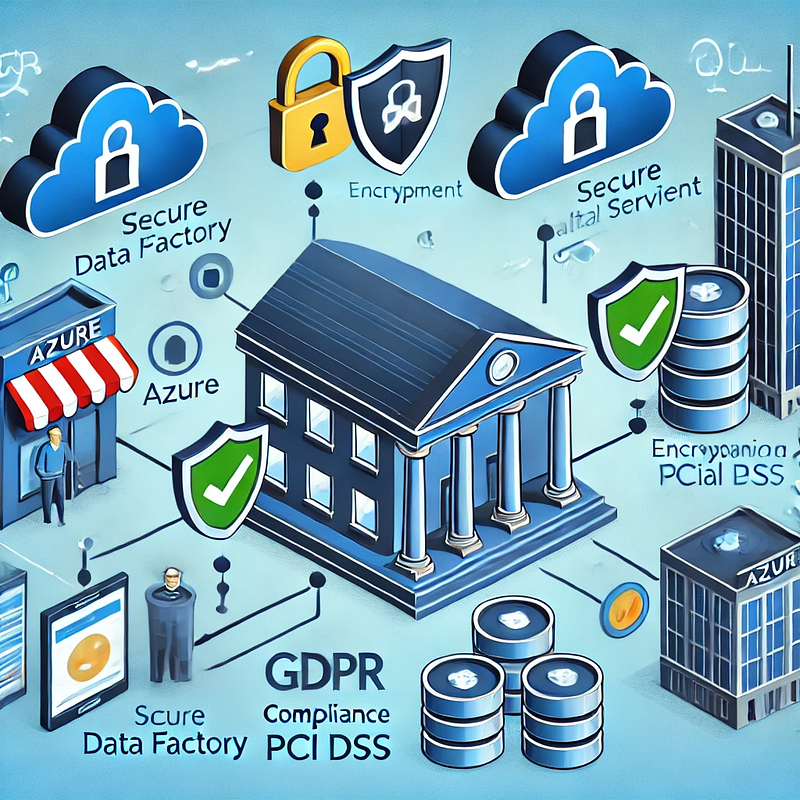
Financial services organizations handle vast amounts of sensitive data, including customer financial transactions, regulatory reports, and risk assessments. Ensuring secure data movement while complying with industry regulations is crucial. Azure Data Factory (ADF) provides a robust, scalable, and secure ETL (Extract, Transform, Load) solution for financial institutions.
Key Compliance Considerations in Financial Services
Financial services organizations must adhere to various regulatory frameworks, such as:
- General Data Protection Regulation (GDPR) — Protects personal data and privacy.
- Payment Card Industry Data Security Standard (PCI DSS) — Ensures secure handling of credit card information.
- Sarbanes-Oxley Act (SOX) — Mandates financial reporting integrity.
- Financial Industry Regulatory Authority (FINRA) — Governs securities firms and brokers.
How Azure Data Factory Ensures Compliance
1. Secure Data Integration and Movement
ADF provides secure data movement across hybrid and multi-cloud environments.
- Encryption: ADF encrypts data in transit and at rest using Azure Key Vault-managed keys.
- Private Endpoints: Prevent data exposure by using Azure Private Link for secure connectivity.
- Self-Hosted Integration Runtime: Enables on-premises to cloud data transfer while maintaining security controls.
2. Data Masking and Anonymization
To protect personally identifiable information (PII), ADF integrates with Azure SQL Database Dynamic Data Masking and Azure Data Lake’s access control policies to restrict access to sensitive data.
3. Audit Logging and Monitoring
Financial organizations need detailed audit trails. ADF offers:
- Azure Monitor & Log Analytics: Tracks pipeline activities and security events.
- Azure Policy & Compliance Dashboard: Helps enforce compliance across data pipelines.
- Role-Based Access Control (RBAC): Ensures least privilege access to sensitive data.
4. Data Lineage and Governance
Using Azure Purview, financial institutions can track data lineage, ensuring transparency in data transformations, storage, and movement. This helps in meeting regulatory audit requirements.
5. Disaster Recovery and High Availability
- Geo-Redundant Data Stores: Azure ensures business continuity with automated failover mechanisms.
- Automated Backup & Restore: ADF integrates with Azure Backup to prevent data loss.
Use Case: Secure ETL for Fraud Detection
A financial institution needs to process large volumes of real-time transactional data to detect fraud.
- Ingest Data: ADF securely pulls data from bank transactions, payment gateways, and mobile banking logs.
- Transform & Mask Sensitive Data: Data transformations remove PII while preserving analytics value.
- Load into a Data Warehouse: Data is securely loaded into Azure Synapse Analytics for fraud pattern detection.
Conclusion
Azure Data Factory offers a compliant, secure, and scalable data integration solution for financial services. By leveraging encryption, access controls, audit logging, and compliance frameworks, financial institutions can confidently move sensitive data while meeting regulatory standards.
WEBSITE: https://www.ficusoft.in/azure-data-factory-training-in-chennai/


Comments
Post a Comment