Explore how ADF might integrate AI/ML capabilities in the future.
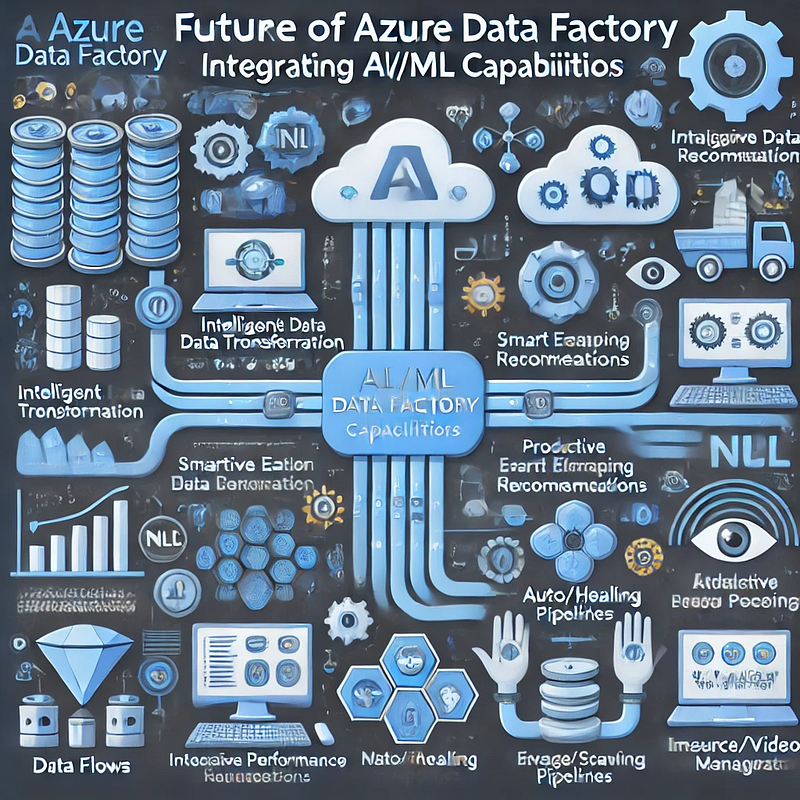
Future of Azure Data Factory: Integrating AI/ML Capabilities
Azure Data Factory (ADF) has established itself as a powerful tool for data integration and ETL workflows. As data pipelines grow more complex, integrating AI/ML capabilities directly into ADF can unlock new possibilities for intelligent data processing. Here’s a look at how ADF might leverage AI/ML in the future:
1. Intelligent Data Transformation
- Automated Data Cleansing: AI models could identify anomalies, correct data inconsistencies, and suggest optimal data cleansing strategies.
- Smart Mapping Recommendations: Using ML algorithms, ADF could suggest column mappings, transformations, or aggregations based on historical data patterns.
2. Predictive Data Flows
- Proactive Error Detection: AI could analyze pipeline performance metrics to predict potential failures or data quality issues.
- Auto-Healing Pipelines: Future enhancements may allow ADF to automatically reroute data flows or adjust resource scaling when anomalies are detected.
3. Advanced Data Enrichment
- Natural Language Processing (NLP): ADF could integrate NLP capabilities to extract insights from unstructured data such as emails, documents, or customer reviews.
- Image and Video Processing: Incorporating Azure Cognitive Services for media file analysis may improve content tagging and metadata extraction.
4. AI-Driven Monitoring and Optimization
- Intelligent Performance Tuning: AI could provide recommendations for optimizing data movement, partitioning, and parallel processing.
- Resource Scaling Predictions: ML algorithms may predict resource requirements based on data size, complexity, and historical trends.
5. Automated Decision-Making in Workflows
- Adaptive Pipelines: AI models could enable dynamic decision-making, such as routing data based on customer behavior or product demand forecasts.
- Event-Driven Insights: ADF could integrate with Azure Machine Learning to trigger data actions based on real-time insights.
6. Enhanced Data Governance with AI
- Intelligent Data Classification: AI models can automatically classify sensitive data, ensuring enhanced security and compliance.
- AI-Powered Metadata Management: Predictive tagging and metadata generation could simplify data cataloging in ADF.
Conclusion
By integrating AI/ML capabilities, Azure Data Factory can evolve from a robust data movement tool to an intelligent data orchestration platform. These advancements would empower businesses to create smarter pipelines, improve data quality, and unlock deeper insights.
WEBSITE: https://www.ficusoft.in/azure-data-factory-training-in-chennai/


Comments
Post a Comment